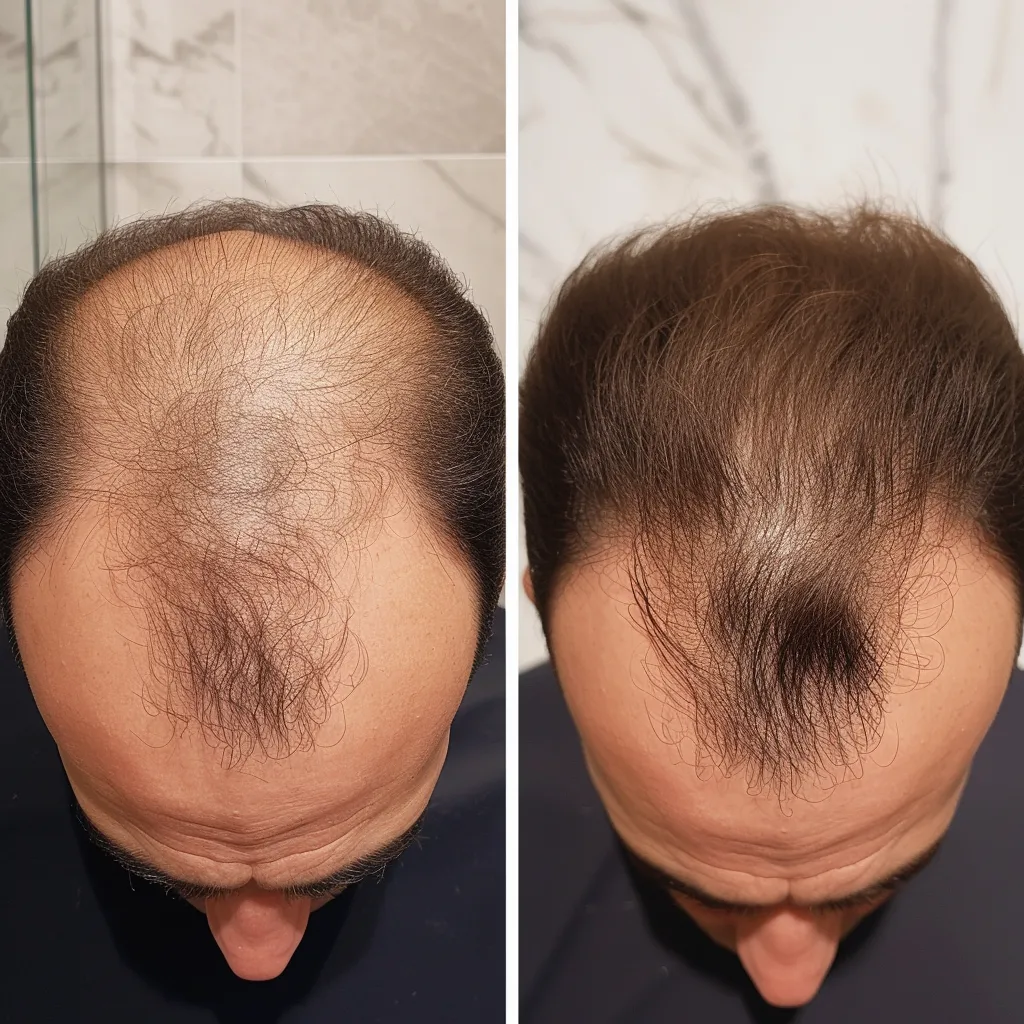
PRP Hair Treatment for Men in Enfield | Hair Loss Help
PRP Hair Treatment for Men in Enfield
Most men meet their hair loss the same way: a photo from behind at a wedding, a barber who goes quiet for a second, or a hairline that has clearly retreated since the last time you really looked. If you have reached the point of doing something about it, PRP hair treatment for men in Enfield at Shamis Health & Beauty on Hertford Road is a drug-free, surgery-free option worth an honest look: a course of sessions using your own blood plasma, given by trained staff, with pre-treatment screening and straight answers first.
Consult → Screen → Treat, if suitable. A 3-session plan, reviewed as you go.
You can book PRP hair treatment directly, but male hair loss rewards the men who understand it before they spend on it — including why timing matters more than any product. Here is the honest map.
Male pattern baldness, in plain English
Around two-thirds of men will notice significant thinning at some point, and for most the story is the same: male pattern baldness. Hair follicles on the temples and crown carry a genetic sensitivity to DHT, a by-product of testosterone. Over the years, affected follicles shrink — each new hair grows back finer and shorter, until the follicle eventually stops showing above the skin at all.
Two things follow from that. First, it is not your shampoo, your hat or your stress levels doing this — it is genetics, which is why it marches on regardless of what you buy at the chemist. Second, the timeline matters enormously: a miniaturised follicle can be supported back towards thicker growth, but a follicle that closed down years ago cannot be argued with. That single fact shapes every honest treatment decision, including whether PRP is right for you.
The NHS guidance on hair loss makes two points we fully endorse: see a GP to understand your cause before visiting any commercial clinic, and remember that no treatment is 100% effective. Sudden or patchy loss in particular deserves a medical look first — pattern loss creeps; anything fast or uneven is a different conversation.
What PRP is, and why men choose it
PRP stands for platelet-rich plasma. We take a small sample of your blood — about the same as an ordinary blood test — and spin it in a centrifuge. That separates the plasma, the golden layer packed with platelets and their growth factors, which is then injected carefully into the thinning areas of your scalp. The aim: deliver a concentrated dose of your own repair signals exactly where follicles are shrinking, and support thicker, healthier growth.
Men tend to choose PRP for three honest reasons. It uses your own blood, so there is no donor material and no synthetic drug. It involves no surgery, no stitches and no downtime beyond a tender scalp for a day. And it fits around life — clients come in from right across North London on a lunch break and go straight back to work.
The main alternatives deserve a fair mention. The NHS lists finasteride and minoxidil as the standard treatments for male pattern baldness — both work only for as long as you use them, and finasteride is prescription-only with side effects some men prefer to avoid. A transplant relocates follicles surgically and suits more advanced loss. PRP sits in its own lane: supporting the follicles you still have, without drugs or surgery.
Which men does PRP suit?
PRP tends to suit men in the earlier chapters: a hairline that has crept back but still has coverage, a crown that is thinning but not yet shiny, a general loss of density that shows up in bright light. If you can still see fine hairs in the area, there is usually something to work with.
It is a poorer bet for long-established bald patches where the skin has been smooth for years — there, the honest conversation is about transplants, and we will say so rather than take your money. It is also not for men with certain blood conditions or on particular medications, which is exactly what screening is for. The men who leave happiest are the ones we were straight with on day one.
PRP hair treatment for men: your 3-session plan
PRP is a course, not a one-off. The standard plan is three sessions, spaced roughly four to six weeks apart, with progress reviewed as you go — then maintenance sessions a few times a year if you are happy with where things settle. We photograph progress (with your permission), because mirrors lie and photos do not.
You will find the clinic at 530 Hertford Road, Enfield EN3 5SS — an easy trip from Enfield Highway, Ponders End, Brimsdown, Southbury and Edmonton, on the 279 and 349 bus routes with parking nearby. We are open Monday to Friday, 10am to 6pm, and Saturday to Sunday, 1pm to 6pm.
Each session follows the same careful shape. The team reviews your progress, takes a small blood sample from your arm, and spins it while you relax. Your scalp is cleansed, and a trained member of staff places the injections across the thinning areas using sterile, single-use equipment — most men describe quick pinches and pressure rather than real pain, and the whole visit usually takes 45 minutes to an hour. Afterwards your scalp may feel tender or look a little pink for a day; most clients go straight back to work or the gym with simple aftercare advice.
If anything concerns you between sessions, call us — and if you ever feel seriously unwell, contact your GP or NHS 111.
Pairing PRP with the right checks
Male pattern baldness is genetic — but not every thinning man is living that story. Low iron, thyroid shifts and hormonal changes can all thin hair, and all of them are checkable in the same building. If your pattern is unusual for your age, or you have felt flat in other ways too, adding a men’s health blood test or a testosterone test to your first visit is a genuinely smart move — same-day results, and a plan built on facts.
PRP also has a sister treatment: the same plasma technique applied to skin, often called the vampire facial, on our PRP hair and skin page. And if you would rather talk your options through before committing to a course, a consultation is always available. Nobody will rush you.
FAQs
Does PRP work on a receding hairline?
It can, with an honest caveat. PRP supports follicles that are still active but weakened, so a hairline that has receded recently — where fine hairs still show — often responds better than one that has been smooth for years. Come in early rather than late; the single biggest factor in your result is how much follicle is still in the game.
How many sessions will I need?
The standard course is three sessions, spaced four to six weeks apart, because hair grows in slow cycles and one session rarely tells the full story. After the course, many men choose maintenance sessions a few times a year to hold their ground. We review progress as we go and will always tell you honestly whether continuing makes sense.
When will I see results?
Think months, not weeks. Reduced shedding is usually the first change, often noticed after the second or third session. Visible thickening takes longer because hair itself grows slowly — most responders judge their results three to six months in. Anyone promising instant regrowth is not being straight with you.
Does PRP hair treatment hurt?
Most men describe quick pinches and a feeling of pressure rather than real pain. The scalp is more sensitive than an arm, so you will feel the injections, but each lasts a second. Tenderness and slight pinkness afterwards are normal and usually settle within a day. If you are needle-nervous, tell us at booking — we will take it gently.
Can I use minoxidil or finasteride alongside PRP?
Many men do combine approaches, and there is no inherent clash — they work by different routes. What matters is that you tell us everything you use at screening, prescription treatments included, so your plan accounts for it. We do not prescribe or supply either drug; those conversations belong with your GP or pharmacist prescriber.
PRP or a hair transplant — which is better?
They answer different questions. PRP supports the follicles you still have, which suits earlier thinning. A transplant relocates follicles surgically and suits advanced loss — bigger cost, bigger commitment, real recovery. Some men do both at different stages of life. If you are unsure which chapter you are in, book a consultation and we will give you an honest steer.
Book Your PRP Hair Treatment in Enfield
Book PRP hair treatment for men Enfield at Shamis Health & Beauty, 530 Hertford Rd, Enfield EN3 5SS. Call 07432 289084 or 07394 690498. Don’t worry — you are in good hands.
Results vary; a consultation decides su